Latest news about the meteorite…….
Sept 22 - more evidence that meteorites brought water to Earth

Dr Ashley King of the Natural History Museum has revealed that extra-terrestrial water has been found in the Winchcombe meteorite. New research shows that it is comprised of water that is very close to that in the Earth’s oceans, suggesting that life may have been seeded on our planet by meteorite strikes. The Winchcombe meteorite was collected only 12 hours after landing, so it is much more likely that its water is extra-terrestrial, and not due to contamination by the Earth’s atmosphere. See here for more details.
Unique mug captures meteorite’s Splashdown

Our new “Splashdown” mug is now available from our shop pages. It has a unique design by Hannah, the only person to have heard the meteorite land, and features the meteorite, the town, a few frightened sheep and the St Peter’s church clock showing the exact time when the meteorite landed!
9 June 2022 - Cheltenham Science Festival

Over a hundred students from local Primary schools came to the Cheltenham Science Festival and heard exciting talks about Meteorites and Space given by experts from the Natural History Museum. They learned what meteorites are, where they come from and how they can tell us about the planets, including the Earth itself.

The students heard all about the Winchcombe Meteorite’s arrival on the earth. They were also able to hold real meteorites and test them with magnets. At the end they tested the experts with some brilliant questions!
7 November 2021 - International scientists study the meteorite

Scientists at many centres are using a range of complex techniques for detailed study of the composition of the meteorite. An international team has been formed which includes experts from London, Glasgow, Strathclyde, Manchester, Leicester, Plymouth, Imperial College, the Open University, Cologne and Canada.
16 October 2021 - Lucy in the sky with asteroids

NASA’s recently-launched Lucy spacecraft will continue the task of understanding how the solar system formed. As well as visiting the Trojan asteroids near Jupiter, it will also visit the asteroid belt between Mars and Jupiter, the former “home” of the Winchcombe meteorite. Photos of the Winchcombe meteorite’s impact site have already been sent to NASA to support its work. This artist’s impression was produced by Lockheed Martin and shows the Lucy spacecraft gathering data as it passes an asteroid. More information here.
7 October 2021 - Plaque marks the spot where the meteorite landed

The square of tarmac where the meteorite landed is now at the Natural History Museum, the hole has been filled in and the drive made good. A plaque now marks the time and place of the amazing event - the moment when a piece of 4.6 billion year old space rock from the asteroid belt first made contact with the surface of planet earth.
6 October 2021 - Public finances hit by meteorite

The Prime Minister, Boris Johnson, used his party conference speech to note that “Margaret Thatcher would not ignore the meteorite that has just crashed through the public finances.” Downing Street sources have not commented on whether or not this was a reference to Winchcombe.
17 September 2021 - the meteorite comes to the Festival

The story of the Winchcombe Meteorite was told to a full house of local residents at the Encounter Church in Winchcombe. The event was part of the excellent Winchcombe Festival of Music and Arts. Pictures here are Rob and Cathryn WiIcock, Prof. Sara Russell of the NHM, John Oldham of the Oldham Foundation who kindly sponsored the event, and Dr. Ashley King of the NHM.
13-17 September 2021 - 1500 school students enjoy “Meteorite Week”

Experts from the Natural History Museum brought an exciting week of educational outreach to 1500 pupils from 12 local schools. Special Meteorite and Space assemblies took place at 8 local primary schools, and 4 secondary schools attended a Meteorite Summit at Winchcombe School. All of the students were able to handle real meteorites and heard fascinating talks about the planets, asteroids and comets. The photo shows Dr Ashley King at Winchcombe School with secondary school students. A BBC regional news team covered the event and their report can be seen here.

Primary school meteorite assemblies took place at Winchcombe Abbey, Gretton, Gotherington, Isbourne Valley, Woodmancote, Grangefield, and the Rissington Schools. The photo shows students learning about the solar system from Dr Helena Bates of the Natural History Museum. They were all very excited and put lots of fantastic questions to the experts. Many of them already knew a lot about the solar system and loved answering the quiz questions at the end of the sessions.

All of the students were able to hold and examine several different meteorites, to see what they felt and smelt like, and test whether they were magnetic. They were thrilled by the idea that they were holding rocks that were older than the planet Earth itself. One particular favourite was a sample of a meteorite from the planet Mars. In the photo, Dr Ashley King talks to Isbourne Valley students about a 4.6 billion year old meteorite.

The meteorite summit at Winchcombe School included a fascinating demonstration by Professor Sara Russell of how comets are formed. Sara mixed water, organic matter (sauce) alcohol (gin), ammonia (household cleaner) soil, and dry ice to magically produce a bucket-sized, icy ball of dirty mini-comet material.

Pictured here at Gretton School, the team for the events at the primary schools consisted of Rob Wilcock, Catherine Harrison, a PhD student from the natural History Museum, Cathryn Wilcock, Dr Helena Bates, Interim Curator of Meteorites at the NHM, and Dr Ashley King, UKRI Future Leaders Fellow at the NHM.

Owls Class at Gretton School sent us this lovely meteorite card. Thank you Owls!
8 September 2021 - The next leg of the Meteorite’s journey

The meteorite’s chosen landing place on the drive began its journey to the Natural History Museum today when the square of tarmac was removed - completely in tact - from the drive and onto a waiting truck. This complex task was expertly carried out by a skilled team from the Grimshaw Group. Once at the museum, the mini-crater will be studied by the scientists, more meteorite material will be recovered, and finally the crater will go on display to the public. The size and depth of the crater should help to shed light on the meteorite’s final approach to the surface of the earth. The BBC TV report is here.
2 September 2021 - Winchcombe Museum - the new home for the Winchcombe Meteorite

The three fragments of the Winchcombe meteorite that we donated to Winchcombe Museum are now on display in the museum’s splendid new Meteorite Room on the first floor. The volunteers who run the museum have done an excellent job providing interesting displays and information about meteorites and the solar system. The new display cabinet allows a great view of the 5 gram fragment as it sits in its special protective glass container. All in all a fitting home for Winchcombe’s oldest and rarest rock.
30 August 2021 - More meteorites land in Winchcombe

An enthusiastic team from the Natural History Museum had a very successful stall at the Winchcombe Country Show on Bank Holiday Monday. They brought with them a piece of the Winchcombe meteorite and several other different meteorite samples. The stall was one of the busiest at the show and was very popular with school age children who loved testing the meteorites with magnets. Some visitors brought their own “meteorites” for identification by the experts, but alas none proved to be the real thing.
15 July 2021 - Scientific research across the world

Scientists from the NHM and the UK academic community will study the material and learn from it for at least the next century, and as time passes new techniques will emerge and new insights will be gained. Experts from all over the world will be able to bid to have some of it, and that way the world’s knowledge about the early solar system will grow. The NHM has already had many requests for material from UK and overseas institutions. The photo shown a fragment of the meteorite with a fusion crust, formed as the surface of the rock melts as it passes through the earth’s atmosphere. Photo: Copyright Rob Wilcock
2 July 2021 - The Winchcombe meteorite - it’s official
Piles of rock and dust come of age as “proper” meteorites by means of a formal classification process run by the Meteoritical Society, the international society for meteoritics and planetary science. Classification involves giving the meteorite an official name and publishing details about its unique characteristics. The classification for the Winchcombe meteorite was issued on 2 July 2021 and can be found here.

15 June 2021 - Where can I see it? How can I learn more?

We have donated the material with the request that it should be used for scientific, educational and display purposes. We hope that as many people as possible can be inspired by the sheer wonder that comes from seeing something that comes from so far away, is older than the earth itself has such mysterious beauty. Fragments found on our property will go on display in August at the Winchcombe Museum and in Spring 2022 at the Wilson/ in Cheltenham. A large fragment found on farmland near Winchcombe is already on display at the NHM.
Photo: Winchcombe Museum Copyright: Rob Wilcock
1 June 2021 - Learning from the meteorite
Material from such a rare meteorite is of huge value for research into the early history of the solar system and the origins of life on earth. Most meteorites are never found because they drop into the sea, hide behind bushes or land in places where penguins or lizards far outnumber humans. If they are found, it’s often many years after they land, by which time the earthly elements have caused changes in the rocks.

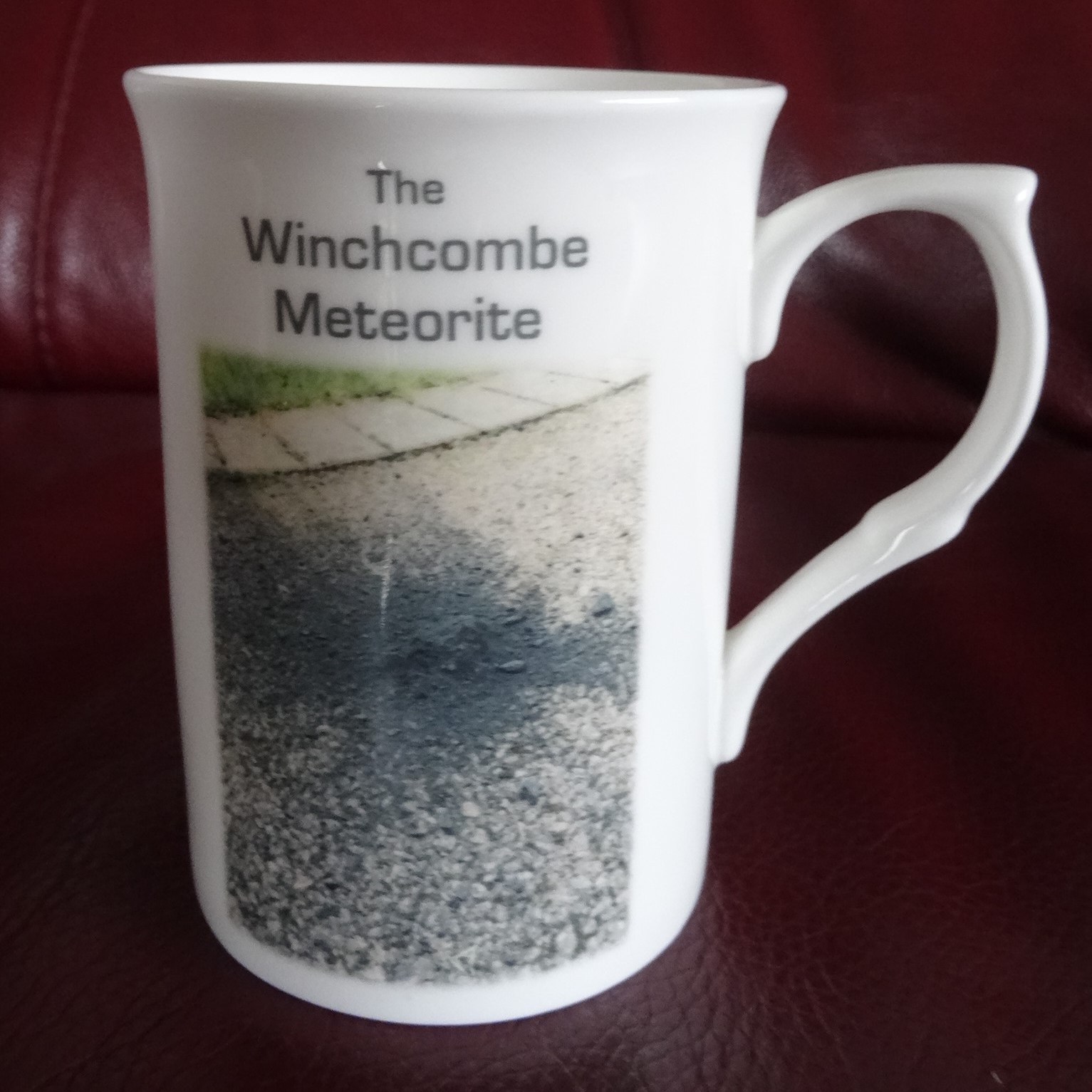
Our bit of the Winchcombe meteorite helpfully splatted down in a place where if we had missed it we would have needed a trip to a well-known opticians. Within twelve hours of it landing, much of it was in clean freezer bags and after three days it was in the Natural History Museum (NHM) in London in protective containers. Its minimal exposure to the earth’s atmosphere should make it almost as pristine as material collected by a space probe. (Photo: The meteorite on the drive, taken only 12 hours after it landed. Copyright Rob Wilcock)
15 May 2021 - The meteorite goes on public display at the NHM

On 15 May a piece of the Winchcombe meteorite went on public display for the first time as the Natural History Museum re-opened after closure due to the pandemic. The 100g stone, with its beautiful fusion-crusted surfaces, was found by the team of scientists on farmland between Winchcombe and Woodmancote. More information on the meteorite’s display at the NHM can be found here.
14 April 2021 - Time to drink to the meteorite!
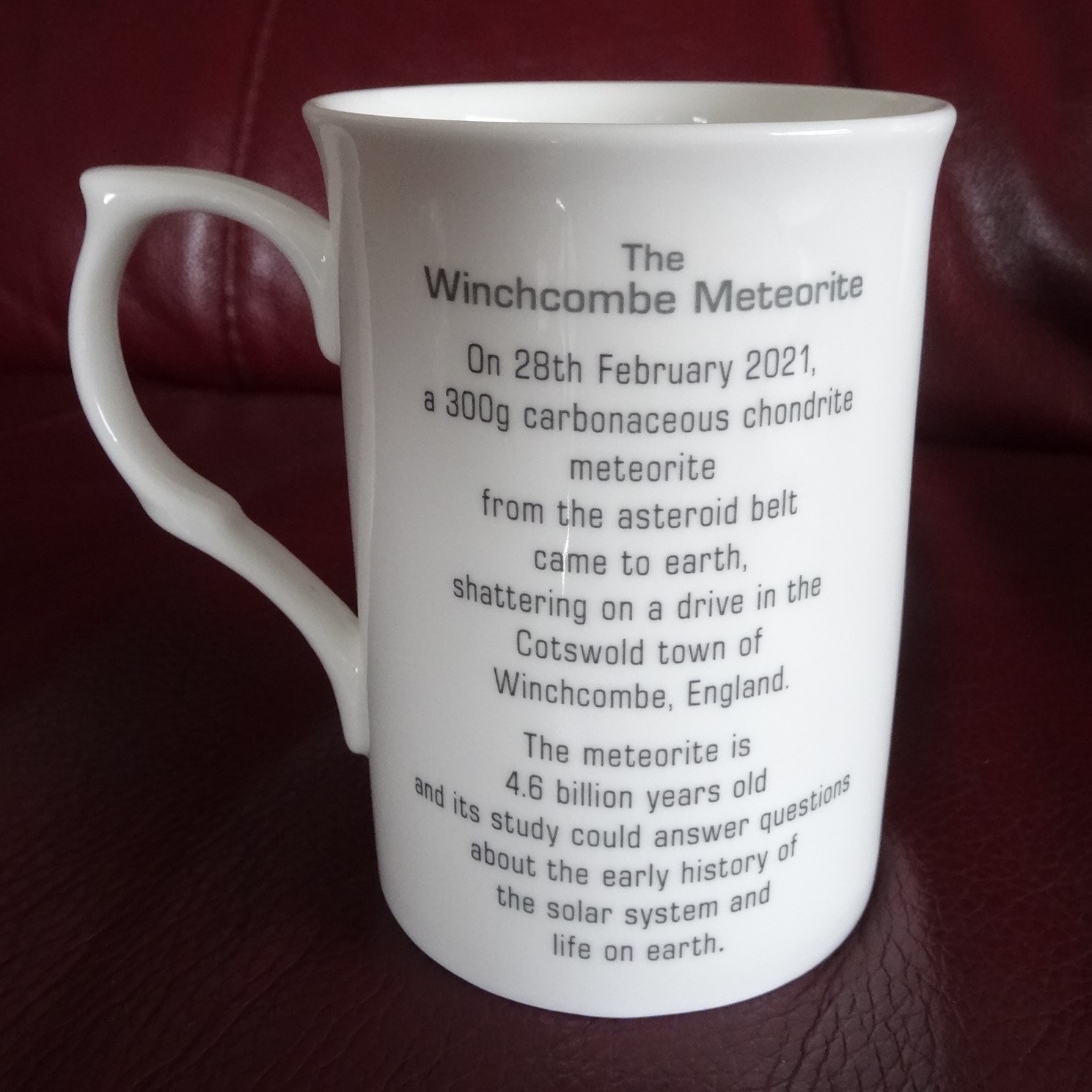
We have commissioned a special commemorative mug. Made from fine bone china, the mug has a unique photograph of the meteorite on the drive, taken less than 12 hours after it arrived on earth. The reverse side gives details about the meteorite itself. The mugs cost £10 and are available from the shop page.